How to watch · Picture and context
Two views. One moment.
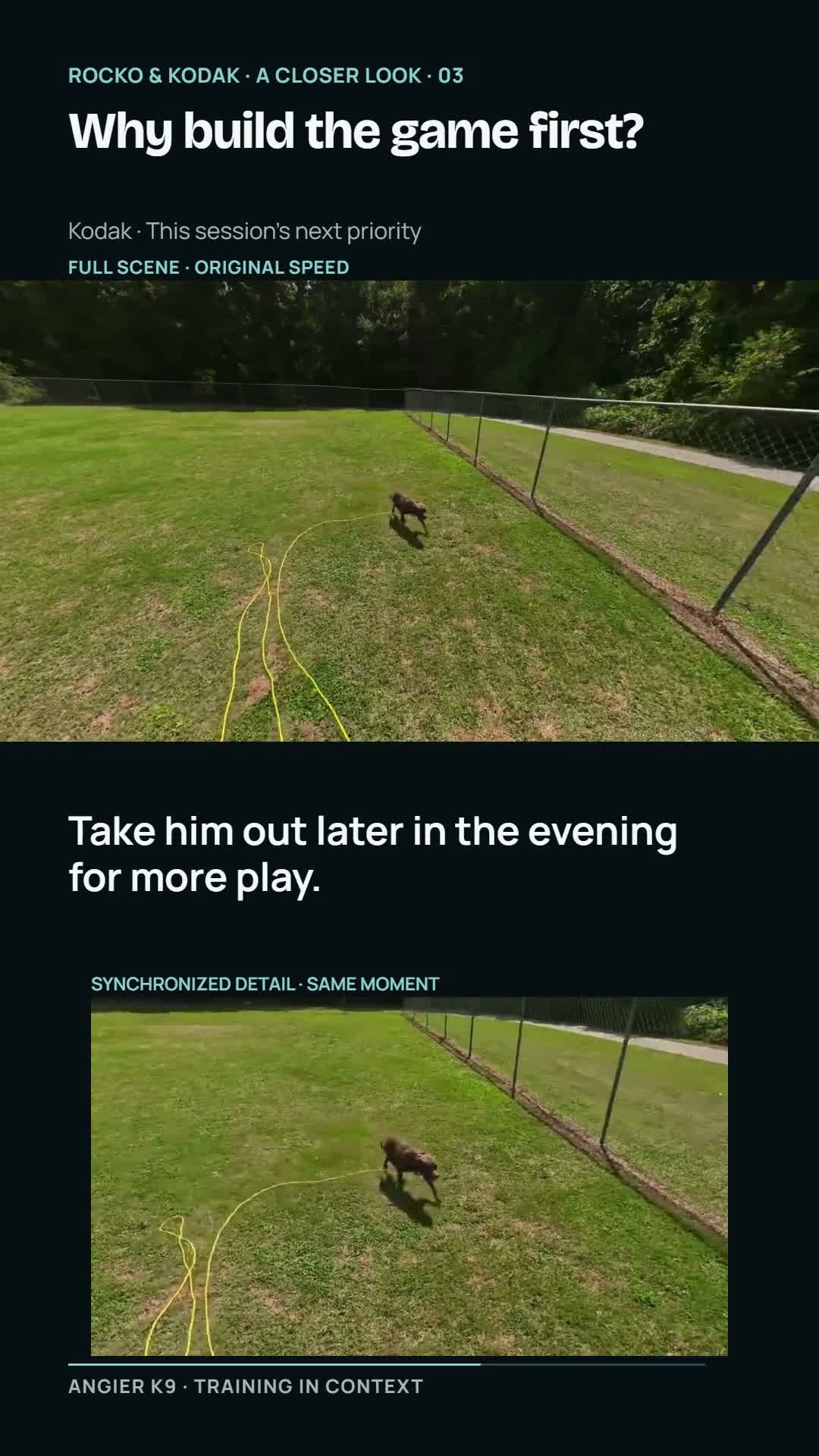
A distant dog can be hard to read in a wide recording. A synchronized detail gives you a closer look while the full scene keeps the person, line and surroundings visible. The two pictures show the same source moment. They do not supply two attempts.
Kodak: the game and the next plan.
This illustration comes from extended Rocko/Kodak chapter 3. The upper picture preserves the original wide scene. The lower picture follows Kodak more closely. Both are at original source time 9:16.
Open the original conversation at 9:10 →
Begin earlier at 8:30 and watch through 9:41 for the game, temperature acknowledgment, proposed evening play and explanation of the current training priority. The closer crop helps you follow the visible dog. It does not show the proposed evening session.
Use the full scene for the conditions.
Follow the handler’s position, the visible line, the dog’s distance and nearby activity in the upper picture. Those details help explain the exchange around a response. A dog-only crop can remove some of them.
Ask what remains outside even the full reframed picture. The longer sessions were recorded with a 360 camera and reframed to select a field of view. That selection keeps the action readable; it does not display every direction at once. The longer-recording guide explains the camera mounts and source format.
Use the detail for what you can actually see.
The lower picture enlarges the same action, making a distant dog easier to follow. When Kodak comes close, the crop can trim part of his body. When the trainer blocks the view in the original source, a crop cannot reveal the hidden action.
Return to the full scene when the detail is incomplete. Neither picture establishes a hidden contact, the dog’s internal experience or the force on a line. Academy’s line guide helps you record what is visible.
Keep one source clock.
In this 71-second chapter, source time begins at 8:30. At chapter time 0:46, both views are therefore at 9:16. The detail runs at the same speed and time as the full scene.
If another edit repeats a moment or uses slow motion, that is a different presentation and needs its own label. Count the original exchange once. A second view of it is more picture information, not independent evidence of another successful repetition.
Two adjacent images also need not be a before-and-after comparison. Check the source ID, time and labels before describing a change. What a montage leaves out adds the role of gaps and selected views.
Choose the question the picture can answer.
Use the detail to follow Kodak; use the full scene to retain the handling context; use the original recording for the surrounding conversation. Kodak’s changing-plan pathway connects this moment to the earlier assessment.
Try Academy’s three-passage observation practice to separate a proposal, an unseen arrival and help within a repetition. For a wider family story, watch Rocko & Kodak: Room for Each Other.